I Know Where the Far Corner Table Is in Every Restaurant in My City

If you've picked the same seat at every restaurant for the last three years, this is going to feel familiar.
I know you arrive early — not because you're punctual, but because you need the right table before someone else takes it. Corner booth. Back to the wall. Where you can see faces.
I know about the head nods. The smile-and-nod when the table laughs and you're still processing the sentence before.
I know you've let phone calls go to voicemail — not because you were busy, but because texting back feels safer than asking "what?" three times.
I know you've texted "can't make it" from the couch on nights when you could have gone.
I know about the exhaustion after every gathering — not physical tiredness, something heavier. Something nobody around you understands.
And I know you've probably started calling it "getting older" because that hurts less than the alternative.
Here's what the strategies aren't telling you: the reason the quiet kitchen works but dinner with six people doesn't has nothing to do with how much hearing you've lost. It's about which sounds are fading — and why louder never fixed it.
What you're about to read isn't a sales pitch. It's a pattern — grounded in audiology research and the words of thousands of people describing your exact situation — that explains why your coping strategies exist, and what's finally changed.
There's now a way to adjust what you hear based on the room you're actually in — not a one-size setting from a test you took in silence.
If the strategies have started to feel less like protection and more like a cage, this is your turning point.
You've gotten strategic about restaurants.
Corner table. Back to the wall. Where you can see everyone's face. You know which side has less foot traffic. You've memorized which booths sit farthest from the kitchen. You arrive fifteen minutes early — not because you're organized, but because you can't risk getting stuck in the middle.
"I like the far corner. With the music off. Preferably with big velvet curtains behind me. And no one else in the restaurant."
You read that and something clicked, right? Because it's your playbook too.
The problem isn't the restaurant. It's the conversation already happening when you sit down — the one you're watching from half a step outside. Someone says something. The table laughs. You get there a beat late, still piecing together the sentence before.
A lot of head nods. That's the skill you've really developed: making it look like you're following along.
You used to be the person who kept the table going. The one who caught the joke before anyone else. Now you're not sure you'd even catch the punchline.
"Life has become a game of Telephone. So much lost by the time it gets to me."
And it's not just restaurants.
There's the phone call you let ring through — not because you were busy, but because phone conversations are harder now, and texting back feels safer than saying "what?" for the third time. There's the work meeting where you stayed quiet because you weren't sure what had just been said, and asking for a repeat felt worse than staying silent.
"Get me around three or more guys all talking over each other and I check out and do not participate."
That's not laziness. That's exhaustion.
By evening, after a family gathering or a dinner out, you're drained in a way that's hard to explain. Not physically tired — something deeper. Your spouse says you've gotten "withdrawn." You say you're tired. You're both right.
It started small. You stopped suggesting new places. Then you stopped going to the ones others chose. You started texting "can't make it tonight" from the couch, alone, on evenings when you could have gone.
"I'm at the stage where I'm starting to turn down invitations to events as I worry that I won't be able to enjoy the experience."
"Maybe there are just environments and places where I can't hear properly and I have to avoid them and my world just narrows slightly."
Slightly.
That word does a lot of work. Enough avoided calls, enough declined dinners, enough nights on the couch, and "slightly" starts to look like a completely different life.
Someone called it becoming "a cave dweller." Not a choice they announced. Just the quiet math of staying home more than going out.
If you've stopped going to things you used to love, you didn't stop because you gave up. You stopped because the cost became too high. The concentration. The anxiety. The exhaustion afterward. The look on someone's face when they think you're not paying attention.
"People sometimes get annoyed because they think I'm ignoring them on purpose."
You weren't ignoring anyone. You were working harder than everyone else at that table. They just couldn't see it.
Here's the thing about all those strategies — the corner table, the early arrival, the seat selection, the avoided calls: they work. They keep things manageable.
But they also keep your world small. And they're built on an assumption that isn't quite right.
There's a specific pattern behind what happens in those rooms — one that explains why the kitchen table is fine and dinner with six people falls apart. And it's not what you think it is.
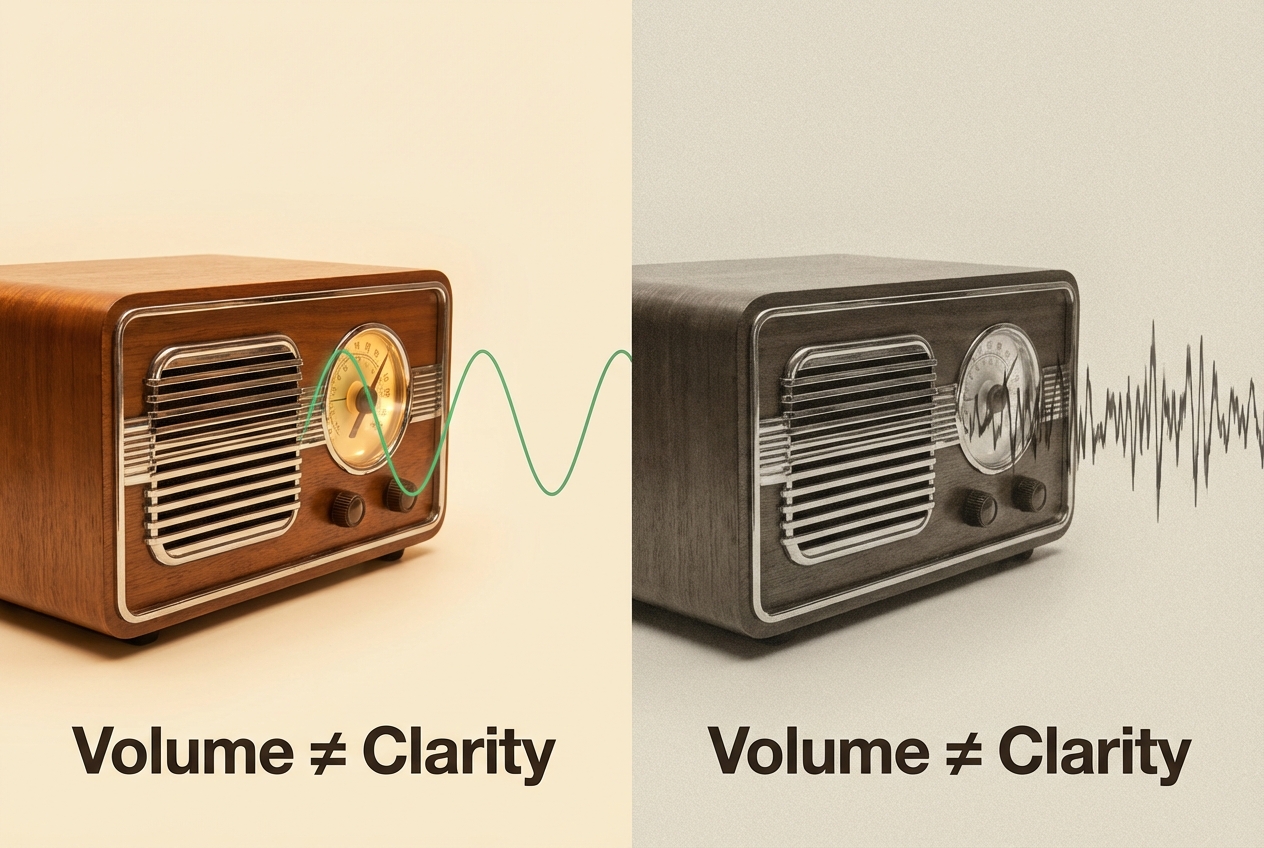
Think about a radio tuned slightly off the station.
You hear something — a voice, the shape of a sentence. You can tell someone is speaking. But the words come through muddy.
Turn up the volume.
The static gets louder. The fragments get louder. But the words don't get clearer.
That's what's happening in your ears.
The sounds that carry the meaning of speech — consonants like S, F, TH, SH — are high-pitched and soft. They fade first. The sounds that carry volume — vowels like AH, EE, OH — are lower-pitched and hold up longer.
Take three words: SIT. FIT. HIT. Completely different meanings. The only difference is one quiet, high-pitched consonant — the first sound to go.
When those consonants fade, you can hear that someone is talking. You just can't always tell what they're saying.
That's why asking people to speak up doesn't fix it. More volume gives you more of what you could already hear. The clarity you need lives somewhere else entirely.
Now here's the part that explains why your coping strategies feel so necessary.
In a quiet room, your brain fills in the missing consonants reasonably well. Some effort, but manageable.
In a restaurant, everything changes. Background voices, silverware, music — they all compete in the same frequency range as the speech you need. The signal and the noise fight for the same space. When you're weaker in that space, the noise wins.
Same ears. Same day. Two completely different experiences.
That's why the kitchen works and the dinner party doesn't. And that mental effort — the constant reconstructing, predicting, gap-filling — is exactly why you're exhausted after social events. Your brain is working overtime while everyone else is just listening.
So what would a real solution actually need?
Four things: Target the specific frequencies where YOUR clarity lives — not boost everything. Adapt to different environments — a restaurant is not a living room. Let YOU adjust in real time. And improve as you learn your patterns.
Until recently, meeting all four meant $2,000-plus and a clinic visit.
That number stuck with me.
Two thousand dollars. Minimum. Plus the appointment. Plus follow-up visits when the first fitting isn't right. Plus walking into a clinic and officially becoming someone who "needs hearing aids" — and the weight that phrase carries.
Even at that price, the most common frustration in every forum is the same: "Works fine at home. Useless at the restaurant."
I spent months looking for something different. Something designed for the specific problem — not "hearing loss" broadly, but that clarity gap in noisy rooms. The restaurant problem. The dinner party problem. The problem that makes you pick the corner table.
Most of what I found did one of three things wrong.
Some just boosted everything equally — speech, noise, clatter, all of it. Like giving every patient the same prescription glasses. Of course it didn't help.
Others tested your hearing once, in a quiet room, and locked in a profile from that single session. Fine at home. Broke down the moment you walked into a restaurant.
And some promised deeper biological repair. But you need clearer conversations in the rooms where you actually live, with the people who matter. That's a today problem.
I was close to accepting the corner table as permanent. Then I found something built around an idea so simple I couldn't believe it hadn't been done this way:
You don't need one setting. You need the right setting for where you are right now.
Meet the Hearstic Clarity
It's called Hearstic Clarity.
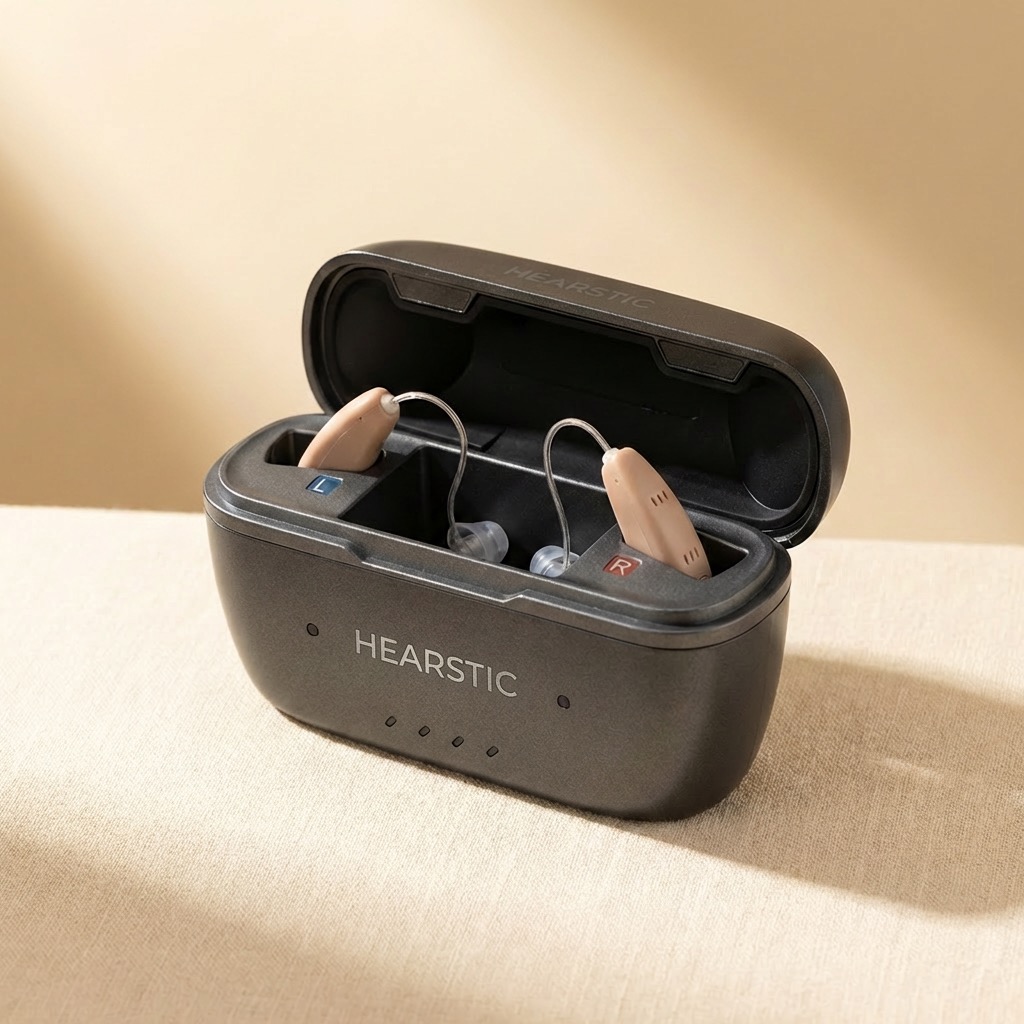
An OTC hearing aid built for adults with mild to moderate hearing difficulty. Not a volume booster. Not a one-size preset. A hearing aid with three distinct modes and a real-time tuning system called Clarity.
The 10-second version: choose your environment, tune three sound bands, done.
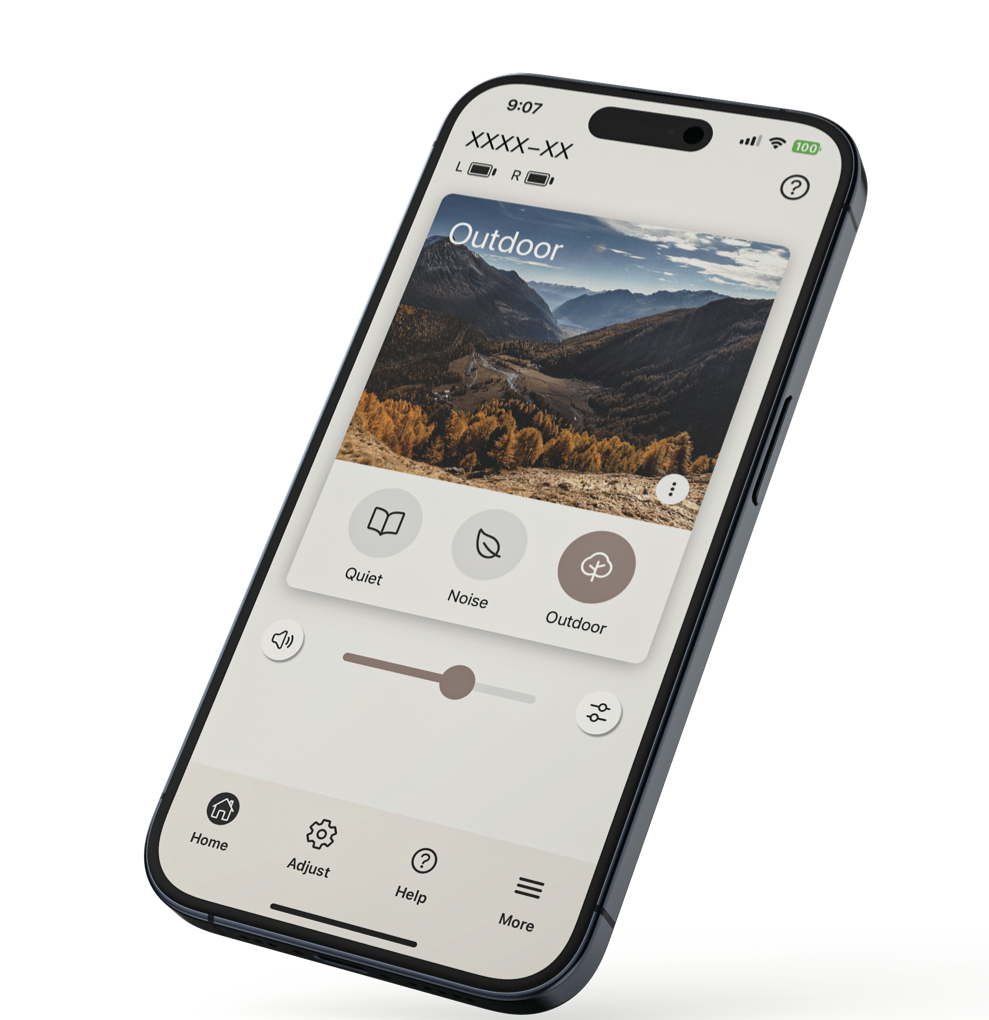
You walk into a restaurant. Switch to Noise mode. Open the HA-Link app on your phone and adjust three sliders — Bass, Middle, Treble — until voices come into focus. Ten seconds.
Three modes for three situations you already know:
Quiet mode — for home, one-on-one conversations, the TV. Where you're already okay. This keeps it that way.
Noise mode — for restaurants, parties, family dinners, work events. The exact situations where your coping strategies kick in. This mode exists because the challenge in noise is fundamentally different from a quiet room — and needs to be handled differently.
Outdoor mode — for walks, outdoor gatherings, open spaces. Different acoustics, different tuning needs.
Each mode adjusts independently for left and right. Because your ears aren't identical.
Noise Reduction cuts background interference. Whistle Suppression handles feedback. Everything runs through the HA-Link app — Android or iPhone.
No appointment. No waiting room. No audiologist deciding what "clear" sounds like for you.
You decide.
Every other approach made the decisions for you — an algorithm guessing, a preset someone else designed, a profile locked from one quiet-room test. Clarity puts the control in your hands. If a setting doesn't sound right, you change it. If the room shifts, you adapt. If you find that boosting Treble two clicks in restaurants brings voices into focus — that's your finding. Your ears. Your adjustment.
If you can adjust the volume on your phone, you can use Clarity.
The receiver-in-canal design sits inside your ear. Most people won't notice unless you tell them.
Battery: over 20 hours per charge. Full charge in 2 hours. Case carries about 3 full charges. Bluetooth connects to your phone for calls and audio.
Wear them morning to night. Wedding, dinner, trade show — no running out.
You don't need the corner table anymore.
Not because your hearing changed. Because you finally have the right tool for the room you're actually in.
Free shipping · 90-day money-back guarantee
What People Are Saying
“The first thing I did was go to the Italian place I'd been avoiding for two years. I sat in the middle of the table. Not the corner. The middle. I followed the whole conversation. My daughter said, 'Mom, you're laughing at the right parts again.' I cried in the car after.”
— Margaret, 61 · Portland
“I answered a phone call yesterday without checking who it was first. Sounds like nothing. For me it's the first time in three years I picked up without planning what to say if I couldn't hear them. Noise mode at restaurants sold me. The confidence kept me.”
— David, 54 · Austin
“I stopped arriving twenty minutes early to every restaurant. I used to need that buffer to pick the right seat. Last week I walked into a birthday dinner ten minutes late, sat in the only chair left — right in the middle. And I was fine.”
— Karen, 67 · Chicago
Day 7: You've tried each mode. Quiet for home. Noise for the coffee shop. You're learning your settings — which slider positions work for your ears, in your spaces.
Day 30: You said yes to the dinner you would have skipped last month. You sat wherever there was a seat. You followed the conversation. Not perfectly — but you were in it.
Day 90: The coping strategies are loosening. You're not planning seating anymore. You're not arriving early to scout the room. You answer the phone. You stay past 8pm. Your world isn't narrowing. It's opening back up.
Free shipping · 90-day money-back guarantee
Why This Costs What It Costs
Why This Costs What It Costs
Three-band tuning, three environment modes, real-time app control, independent left/right adjustment — the same level of personalization as a $2,000+ clinic-fitted device. Without the clinic. Without the multi-thousand-dollar bill.
Fair Warning
These are selling faster than expected. The combination of Clarity tuning with the $299 price point has created more demand than initial production anticipated. If it shows in stock today, that's current — but it may not stay that way.
This Isn't a $20 Volume Booster
It isn't a generic device from a late-night ad that makes everything louder — including the noise that's already drowning out speech.
It isn't a $4,000 clinic-fitted hearing aid either. You don't need a specialist to tell you what sounds right in your own kitchen.
Hearstic Clarity sits in between — precision that used to require a clinic, at a price that doesn't require a payment plan.
$299 Per Pair
$299. Not per ear. Both sides. Ready to go.
That's about $1 a day over the first year. Less than the coffee you grab on the way to the restaurant you've been avoiding.
- Audiologist-fitted hearing aids: $2,000–$6,000+ per pair
- "Premium" OTC aids with fewer features: $500–$800
- The dinners you've skipped, the calls you've dodged, the invitations you've declined: incalculable
What You Get
- Hearstic Clarity hearing aid pair
- Charging case (USB-C)
- Dome tips, cleaning brush, wax guards
- Charging cable + user guides
- HA-Link app — free download
- Expected device life: 5 years
Every Day with the Strategies
Every week with the coping strategies is another week your world stays the same size. Another dinner declined. Another phone call dodged. Another evening on the couch when you could have been at the table.
The mental effort of compensating doesn't decrease with time. It builds. The habits of avoidance get deeper, not looser. The gap between you and the people you care about gets wider, not narrower.
The corner table will still be there tomorrow. The question is whether you want to keep needing it.
Hearstic Clarity
$299
Per pair. Not per ear. Both sides. Ready to go.
What You Get
- ✓Hearstic Clarity hearing aid pair
- ✓Charging case (USB-C)
- ✓Dome tips, cleaning brush, wax guards
- ✓Charging cable + user guides
- ✓HA-Link app — free download
- ✓Expected device life: 5 years
Try It with Zero Risk
90-day money-back guarantee. Full refund. No restocking fee. Free return shipping. 90 days from delivery to decide.
- 90-day money-back guarantee
- Full refund — no restocking fee
- Free return shipping
- 2-year manufacturer warranty covering full replacement for defects
- If it doesn't work in your restaurants, your family dinners, your life — send it back. Every penny returned.
- We take the risk. You take 90 days to find out if the corner table becomes optional.
Free shipping · 90-day money-back guarantee
Questions You Might Have
Most people feel it the first time they switch to Noise mode in a challenging environment. Learning your ideal slider positions takes a few days. Give yourself a week to explore all three modes. A month to really dial things in.
That's what Noise mode is built for. The three-band EQ lets you boost speech clarity frequencies while the Noise Reduction toggle cuts background interference. It won't make a noisy room silent — but it can make the voices clearer. That's the difference.
HA-Link walks you through pairing. Connects via Bluetooth. Most people are up and running within 10 minutes. If you've connected wireless earbuds, this is similar.
The receiver-in-canal design sits inside the ear canal. More discreet than behind-the-ear styles. Most people won't notice in normal conversation.
90-day money-back guarantee. Full refund, no restocking fee, free return shipping. Try them in your actual life — your restaurants, your gatherings, your phone calls. If they don't help, send them back.
Over 20 hours per charge. Full charge in 2 hours. The case holds about 3 more full charges. Morning through late dinner, no problem.
No. Hearstic Clarity is an OTC hearing aid for adults 18+ with perceived mild to moderate hearing difficulty. No prescription, no fitting appointment, no clinic visit required.
Yes. Bluetooth with 10-meter range. Works with Android 9+ and iOS 12+. Calls stream directly through the hearing aids.
Hearing aid pair, charging case (USB-C), dome tips, cleaning brush, wax guards, charging cable, and user guides. HA-Link app is a free download.
Three ways. First: three environment modes — Quiet, Noise, Outdoor — not one fixed setting. Second: real-time Bass/Middle/Treble tuning through the app — you control it, not an algorithm. Third: independent left/right adjustment. If what you tried before made everything louder without making anything clearer, Clarity is built to address that specific problem.
Free shipping · 90-day money-back guarantee
One More Thing
Every month you put this off, the compensating gets harder. The fatigue builds. The conversations you miss today become distance between you and the people you care about.
Research has found associations between prolonged unaddressed hearing difficulty and higher risk of cognitive decline — associations still being studied, and serious enough that the FDA notes hearing aids may help reduce these risks.
You've been managing this on your own long enough. The corner table. The declined invitations. The nodding along. You built an entire system to protect yourself — and it worked. But it also kept you on the outside of the life you used to live.
You don't have to keep choosing between comfort and connection.
Free shipping · 90-day money-back guarantee
Hearstic Clarity is an OTC hearing aid intended for adults 18 and older with perceived mild to moderate hearing loss. It may not fully replace natural hearing ability and does not prevent or improve medical conditions causing hearing loss. Individual results may vary. If you experience sudden hearing changes, ear pain, drainage, or dizziness, consult a healthcare professional before use.