She Was Talking to Me From the Kitchen. I Smiled Like I'd Heard Every Word.

You know that moment. You're at the table. Your partner is at the sink, back turned, talking. You can hear the shape of a sentence — the rhythm, the rise at the end of a question. But the actual words? Gone.
You say "what?"
They turn around and repeat it. You catch most of it this time. Enough to nod. But not enough to be certain.
You know what it's like to say "what?" and immediately feel the slight weight of it — the tiny tax on the conversation. The thing you didn't want to become.
You know the look. The one that isn't frustration exactly. More like a kind of tired patience that you both understand without naming it.
You know the guilt. The one that says: I know they shouldn't have to repeat themselves. I know this.
You know the nod. The one where you caught enough to guess at, and you answered — and then you weren't entirely sure the answer made sense. And you held very still hoping no one would notice.
You know the TV standoff. Your number. Their number. The slow drift between them that became the kind of thing neither of you quite talks about.
You know what it is to pull back from a conversation not because you don't care — but because trying became too expensive. Too much effort for too little return.
And somewhere in the middle of all of it, a thought crept in: Maybe this is just how it is now.
It's not.
What you're about to read isn't another suggestion to move closer or speak up or try harder. It's the reason none of those things actually worked — and why turning the volume up will never fix the problem you actually have.
This might be the answer you stopped believing existed.
You've had this conversation a hundred times from this exact position. You at the table. Her at the counter, talking at the tile, voice carrying back over her shoulder.
It's not that the kitchen is loud. The dishwasher might be running. The range fan, maybe. But it's not a loud room. You should be able to hear from here. You used to hear from here.
Somewhere along the way, you stopped being able to.
Not all at once. There wasn't a day when it went. Just a slow drift — month by month, year by year — until one ordinary afternoon you realized you were watching the back of her head and understanding almost none of it. And you'd already said "what?" twice, and a third time felt like too much, so you said "mm-hmm" instead.
You told yourself it was the fan. The dishwasher. The acoustics of the room.
Then she started doing something different. You noticed it gradually: she was speaking a little slower. A little more clearly. Facing you more often before she started a sentence. She read somewhere that lower-pitched voices are easier to hear, and she'd been trying to pitch her voice lower when she talked to you.
She was trying to help. She didn't know it actually made it harder — the pitch adjustment doesn't fix the problem, because the problem isn't about pitch in the way she was thinking. But she was trying. Because that's what partners do when they love someone who's struggling with something neither of them has a name for yet.
You noticed it. And you felt it.
There is a specific kind of guilt that lives in knowing someone is working around you. The extra effort they put in — the repetitions, the slower speech, the facing-you-before-talking — isn't a complaint. It's accommodation. And accommodation, however kindly given, is a reminder of the gap.
You started compensating. You got better at reading faces — watching the expression for cues about whether the sentence was a question, a joke, an observation. You learned to ask your follow-up questions at an angle, so if you'd misunderstood, it wouldn't be immediately visible. You got good at recovering.
Only if you were looking directly at each other did you really catch everything. You noticed that. It became a kind of rule you kept privately.
But at the kitchen table, with her back at the sink — the rule didn't help.
You miss things in your own house, with the people you've known for years. That's the part that sits quietly in the back of everything: it's not a restaurant, it's not a crowd, it's not an acoustically difficult space. It's your kitchen. And the person talking to you is the person you most want to hear.
And somewhere in the middle of all those "what?"s and nods and compensations, the gap between you started to widen — not dramatically, not in any way that anyone would point to. Just incrementally. The way conversations get a little shorter when one side stops being sure the other is catching everything. The way you start summarizing less, sharing less, because the cost of having to repeat it is something neither of you wants to think about.
One evening, after a particularly bad run of missed words at dinner, you sat with that thought: This is affecting my mental health.
And you started looking for a real answer. Not another tip. An answer.
The TV was where it got harder to ignore.
You needed the volume higher than they did. That gap — your number vs. theirs — became a kind of negotiation you had every evening. High enough that you could catch the dialogue. Low enough that it wasn't uncomfortable for the person sitting next to you.
Some nights you found the number that worked for both. Other nights one of you gave up the negotiation and went to another room.
You started using subtitles. "Just for this show," you told yourself. That was a while ago. The subtitles are still on.
Then the family dinners. Three conversations at once — that's a family dinner. You used to be in the middle of them. Jumping in, finishing thoughts, tracking three threads at the same time. Somewhere along the way, you moved to the edges.
A family gathering last month. Kids running around. Three adults at the table talking. You nodded. You smiled. You picked up enough context to stay close to the surface of the conversation, but the actual words — specific words, specific sentences — kept slipping. You came home drained. Not from the people. From the effort.
You tried things.
You repositioned furniture — closer to where people usually sat. You asked people to face you more. You turned the volume up, then up again, until the person next to you was watching the show with a kind of tense patience. You bought a soundbar. The soundbar made the room fuller of sound. It did not make the dialogue clearer.
Maybe you went further. Maybe you tried a pair of OTC hearing aids. And they made everything louder — the TV, the fan above the stove, the refrigerator hum — but the words still got lost. You kept nodding and smiling at the dinner table like you had before you put them in. You returned them. Or you put them in a drawer.
Because louder wasn't what you needed. You could already hear the sounds. Adjusting the volume up and down didn't improve the situation. What kept getting away from you wasn't sound — it was something inside the sound.
You started withdrawing. Not dramatically. You said no to the dinner invitation not because you didn't want to go, but because you already knew how the evening would unfold — nodding along at a table full of voices, exhausted by nine, driving home wondering what you'd missed.
Some people stop going out. Start avoiding the situations where the gap is most visible. You weren't there yet. But you could see it from where you were standing.
You started searching. Not for another gadget. For an explanation.
Something wasn't specifically wrong with any of the things you'd tried. But nothing was specifically right, either. And until you understood why, nothing you tried next was going to be different.
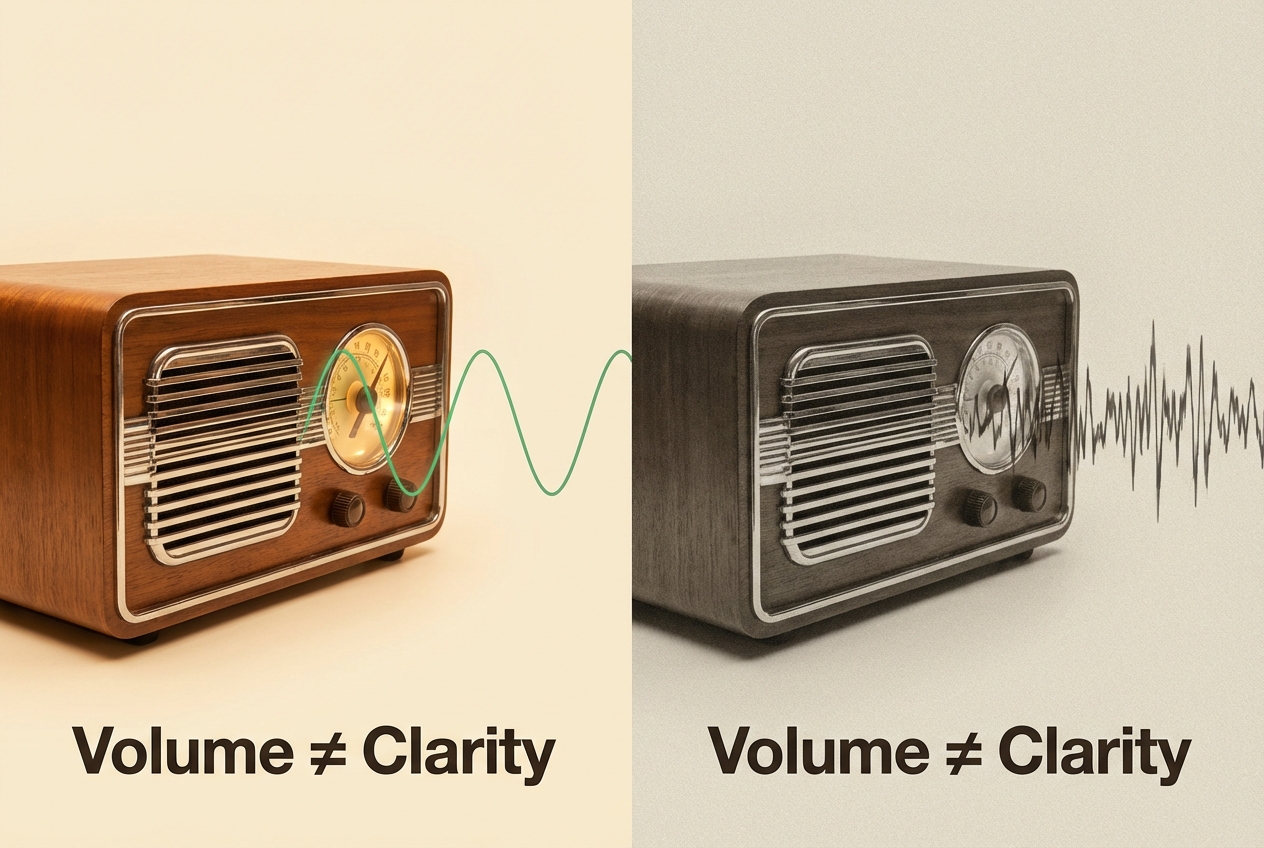
Think about a radio tuned slightly off the station.
You can hear something — a voice, music, the shape of a broadcast. But the words come through muddy. You can tell it's playing. You just can't make them out.
Turn up the volume. The static gets louder. The words don't get clearer.
That's what's been happening.
Every spoken sentence carries two types of sounds. Vowels — the ah, ee, oh sounds — are loud and low-pitched. They usually come through fine. Consonants — S, F, TH, SH — are different. They're soft, high-pitched, and they're the sounds your brain uses to tell one word from another.
Take three words: SIT. FIT. HIT. Completely different meanings. The only difference between them is that first consonant — quiet, high-pitched, and the first to fade when hearing changes.
That's why you can hear that someone is talking but not what they're saying. The volume is there. The shape of the voice is there. The specific sounds your brain needs to decode meaning — those are the ones going missing.
You can hear a cat meow from another room, but miss a word spoken directly to you at the kitchen table. That's not random. Different sounds live in different frequency ranges. When the frequency range where consonants live becomes harder to resolve, those sounds blur — while sounds in other ranges come through clearly. Volume turns everything up equally. It doesn't fix a gap in a specific frequency range.
Turning up the TV doesn't fix this. More volume gives you more of what you could already hear. The clarity you're missing needs something entirely different.
You've probably noticed the pattern. One-on-one in a quiet room — you manage. Walk into a restaurant, or sit at a table with three conversations running at once — and you've lost the thread entirely.
Same ears. Same day. Completely different experience.
In a quiet room, your brain fills in the missing pieces reasonably well. Add background noise — other voices, silverware on plates, music, a refrigerator cycling — and those sounds compete in exactly the same frequency range as the consonants you're trying to resolve. The signal and the noise fight for the same space. When your hearing is already weaker in that range, the noise wins.
This is a signal-separation problem. Not a volume problem.
There's a hidden cost to this that nobody talks about. Every time you miss a word, your brain keeps working — predicting, guessing, reconstructing from context. It's running a constant repair job, all day, in every conversation. By evening, you're not just tired from the conversation. You're drained from the effort of keeping up with it.
The withdrawal from social situations? The choosing the couch over dinner out? That's your brain protecting itself from another evening of that effort.
It's not you. It's not that you're getting old. Your brain is working significantly harder than everyone else's just to follow a normal conversation.
Which means any real solution has to do four things:
- Target your specific frequency gaps — not a generic boost across all sounds
- Adapt to different environments — your living room and a restaurant are genuinely different problems
- Let you control it in real time — adjust in the moment, not rely on preset settings someone else chose
- Get better as you learn your own patterns
Until recently, meeting all four criteria meant $2,000 or more and a clinic appointment. That's changed.
Once you understand the real problem — frequency-specific clarity, not volume — one question becomes obvious:
Why isn't anyone building something that targets the sounds I'm missing, in the room I'm actually in, and lets me adjust it myself in real time?
Here's what the people who have been living with this problem said they needed: "Isolate voices, reduce almost everything else, and increase the voices. Now we can hear." That's not a marketing line. That's someone on a hearing forum describing exactly what a real solution would have to do.
I looked at what existed. Basic devices that made everything louder — the dialogue, the background noise, the refrigerator hum, all of it equally amplified. The same problem, bigger. Audiologist-fitted hearing aids at $4,000 to $7,000 — multiple appointments, weeks to dial in, and forums full of people who spent that money and still couldn't hear clearly in a restaurant. OTC options built on the same amplification logic as the basic devices — no frequency targeting, no environment adaptation, no real-time control you could actually use.
None of them solved what the problem actually was.
Then I found a team that had refused to ship until they built something that did.
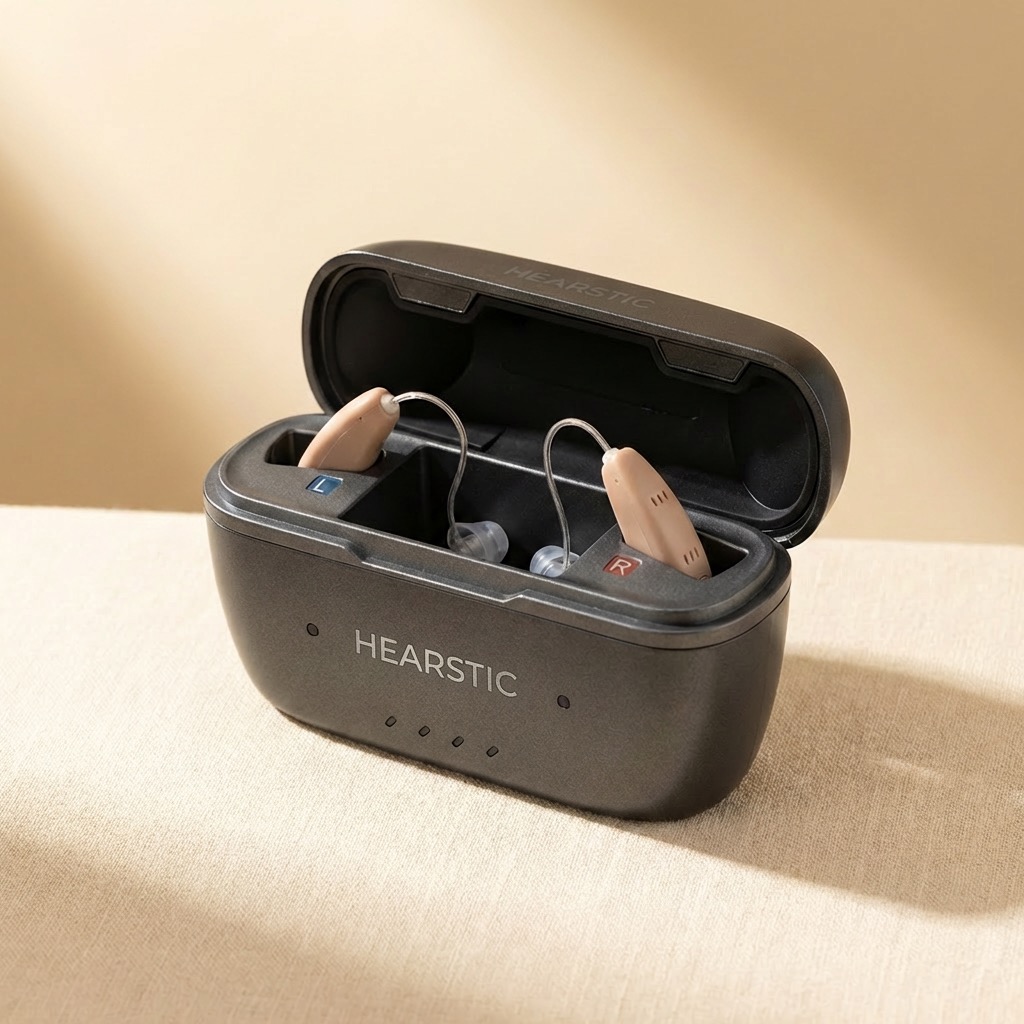
It's called the Hearstic Clarity. An OTC hearing aid built around the four criteria that matter — not as a feature list, but as the actual engineering brief.
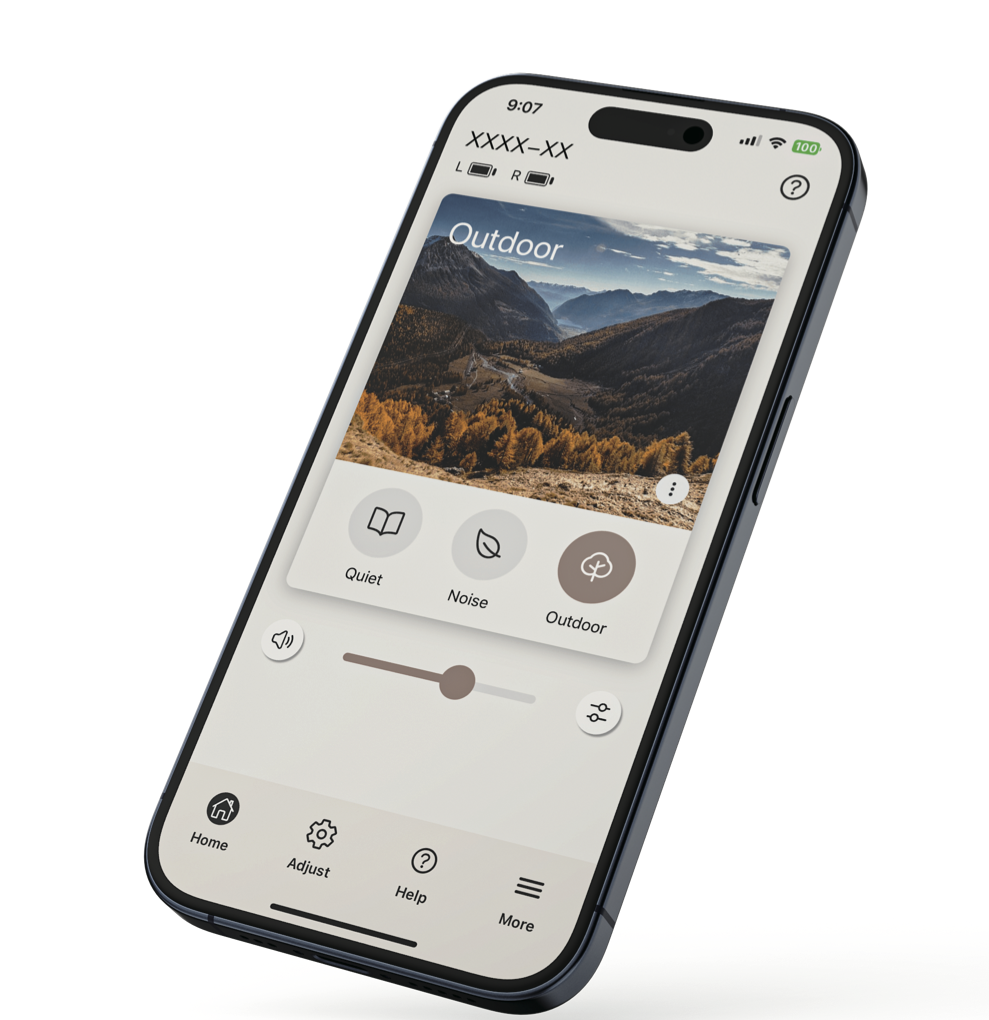
Your frequency gap, not an average. The HA-Link app gives you real-time control over three sound bands — Bass, Middle, and Treble. The consonant sounds that carry speech clarity — S, F, TH — live in the Middle and Treble range. You boost exactly where your clarity is fading, and leave everything else alone. Each ear independently, because your ears aren't identical.
Your environment, not a guess. Three modes built in — Quiet, Noise, and Outdoor. Sitting in your living room? Quiet mode. Walking into a restaurant? Switch to Noise mode before you sit down. The mode doesn't just turn things up — it shifts the signal balance, cutting the low-frequency background rumble and lifting the speech frequencies into focus. It's not a volume change. It's a different kind of listening.
You stay in control. Adjust from the HA-Link app on your phone, in any room, at any moment. No audiologist. No waiting room. If it doesn't sound right for your ears in your kitchen tonight, you change it. Right now. Not at a follow-up appointment three weeks from now.
It gets better as you learn. Not a locked-in factory setting from day one. The more you use it across the situations that matter to you — kitchen table, car, family dinner — the more precisely you dial in what YOUR ears need in each one.
Noise Reduction dims background clutter so speech stands forward. Whistle Suppression eliminates feedback. Battery runs over 20 hours per charge. Works with Android 9+ and iOS 12+. If you can adjust the volume on your phone, you can use the Clarity.
This isn't about making your world louder. It's about hearing the people in it clearly.
Free shipping · 90-day money-back guarantee
What People Are Saying
Real words from adults describing the hearing difficulty Hearstic Clarity is designed to address. None of these individuals have reviewed or endorsed the product.
“My hearing is 'fine' in most circumstances — I can hear them say something. I just can't understand the words.”
— From a hearing community forum
“Thanks — it's really just my wife I want to hear the first time. She's suffering from 'what?' fatigue. And so am I.”
— From a hearing community forum
“You'd have to be able to isolate voices from everything else. Period. Isolate voices, reduce almost everything else, and increase the voices. Now we can hear.”
— From a hearing community forum

What the first 90 days look like
Week one. You're sitting at the table. Your partner starts talking from the sink — the usual position, face toward the tile. You switch to Quiet mode. You catch it. Not most of it. All of it. You don't say "what?" You answer the actual question they asked. They pause for a second — just a beat — and something in the room is different. Neither of you says anything about it.
Month one. You've dialed in your Quiet mode settings for the kitchen. Kitchen conversations happen without you bracing for the automatic "what?" Your partner starts talking to you from farther away again — naturally, without thinking about it. You notice before they do.
Month three. The TV volume isn't a subject anymore. You went to a family dinner last weekend and kept up — not by watching faces and filling gaps, but by actually hearing. You came home energized instead of drained. Your partner says something small: "It's been so nice not having to repeat myself." That one sentence tells you everything you needed to know.
Free shipping · 90-day money-back guarantee
Let's Talk About What This Normally Costs
You've probably already spent money trying to solve this. The soundbar. The furniture rearrangement. The turned-up volume that pushed your spouse to the other room. Maybe an OTC device or two that went back in the drawer after a week.
Maybe you looked at what prescription hearing aids actually cost and quietly closed the browser. The audiologist quote. The $5,900 one, or the $6,900 "most advanced" one. That's what the category has been asking you to pay.
The question isn't what this costs. It's what it costs you to keep living with the problem.
Here's the honest picture of what's been available:
Audiologist-fitted hearing aids: $2,000–$7,000 per pair. Multiple appointments to fit and dial in. Weeks before the settings are right. People on forums who spent that amount still report struggling with speech clarity in restaurants. The money buys access to the clinic — it doesn't guarantee the result you need.
Generic amplifiers: $30–$100. They make everything louder — the background noise, the refrigerator hum, the conversation you needed. Same problem, bigger.
OTC hearing aids built on amplification logic: No frequency targeting, no environment modes, no real-time control. The fundamental issue — clarity vs. volume — unchanged.
You've been choosing between too expensive and not good enough.
The Clarity is the space between: OTC hearing aid technology with the kind of real-time tuning that used to require clinic visits. Without the clinic. Without the cables. Without the price tag.
Hearstic Clarity
$299
Full kit — both hearing aids, charging case, dome tips, cleaning tools. No monthly subscription. No hidden fees.
What You Get
- ✓A pair of Hearstic Clarity OTC hearing aids (left and right)
- ✓Charging case — USB-C, charges the pair about 3 times per case charge
- ✓HA-Link companion app — free, Android 9+ / iOS 12+
- ✓3 environment modes: Quiet, Noise, Outdoor
- ✓Real-time 3-band EQ with independent left/right control
- ✓Noise Reduction and Whistle Suppression built in
- ✓20+ hours of battery life per charge
- ✓Bluetooth call and audio support (10-meter range)
- ✓Dome tips, cleaning brush, wax guards, charging cable
- ✓User guides — no audiologist appointment required
- ✓90-day money-back guarantee
- ✓2-year manufacturer warranty
Free shipping · 90-day money-back guarantee
The Cost of Waiting
Every month the pattern continues, the distance gets a little wider.
It's not dramatic. There's no single moment. It's the inside jokes that get told and you catch the shape but not the words. It's the dinner table conversations that get gradually shorter — not from anger, but from the quiet exhaustion of one side having to repeat and the other side already knowing what's coming. It's the partner who used to say "you should come, you'd love it" who stops asking — not out of exclusion, but because they already know the evening costs you something it doesn't cost them.
The relationships you're working to maintain today don't get that time back. The person who used to tell you everything from the kitchen doesn't stop loving you. They just gradually tell you less.
Research published in The Lancet has identified untreated hearing loss as one of the leading modifiable risk factors associated with cognitive decline. This isn't meant to frighten you. It's one more reason not to treat this as something you'll deal with later.
The cost of waiting isn't the price of the device. It's the conversations you don't get back.
90-Day Money-Back Guarantee
We don't want you to guess. We want you to try it. Not 30 days. Not 60. Ninety full days to test it in the situations that actually matter to you — at your kitchen table, in the car on the way home from work, at the family dinner where three conversations are running at once, at the restaurant you've been avoiding. Ninety days in your actual life. If it doesn't work for your ears — in your specific kitchen, with your specific family — send it back. Email us. We handle the return. Free return shipping. Full refund, no restocking fee. No phone calls required to start the process. We understand that hope has a cost — that you may have tried things before and been disappointed. We're not asking you for hope. We're asking you for 90 days in your own kitchen to find out whether this is different. Because 90 days is enough time to dial in the settings. To test it in every situation that matters. To know — not guess, know — whether this works for your ears. We're not asking you to take a leap of faith. We're asking you to try it for 90 days, in your actual kitchen. Note: Return process details including specific timelines are confirmed accurate at the time of this publication.
- Full refund — no restocking fee
- Free return shipping
- 2-year manufacturer warranty (full replacement for manufacturing defects)
Free shipping · 90-day money-back guarantee
Frequently Asked Questions
The HA-Link app works on Android 9.0+ and iOS 12.0+. If your phone is from the last five or six years, you're covered. The Clarity connects via standard Bluetooth — no Apple MFi protocol required, no special phone needed.
Most people notice clearer speech within the first few days. The real improvement comes over two to four weeks as you dial in your settings for the specific environments that matter to you — your kitchen, the car, a restaurant. The 90-day guarantee gives you time to learn what your ears need.
No. You can switch between Quiet, Noise, and Outdoor modes and adjust volume using the button on the device itself — no phone required. The HA-Link app adds real-time three-band EQ and per-ear adjustment for more precise tuning. Most people use both.
Noise mode and the Noise Reduction toggle are specifically built for this. Switch to Noise mode in loud environments — it cuts the low-frequency background rumble and lifts speech frequencies into focus. Adjust the Treble in the app to bring consonants forward. It doesn't just make things louder — it changes what the signal balance prioritizes.
The Clarity is an OTC hearing aid designed for adults 18+ with perceived mild to moderate hearing difficulty. No prescription or audiologist visit required. The user manual includes specific conditions where you should consult a healthcare professional first — including sudden hearing changes, ear pain, drainage, or dizziness.
Over 20 hours per charge. Full recharge in 2 hours. The charging case holds about 3 full charges — so you can go multiple days without plugging anything in.
Return it within 90 days for a full refund — no restocking fee, free return shipping.
Both hearing aids (left and right), a USB-C charging case, dome tips in multiple sizes, a cleaning brush, wax guards, a charging cable, and user guides. Everything you need — nothing else to buy.
2-year manufacturer warranty. Full replacement for manufacturing defects. Does not cover loss or physical damage.
The Clarity is designed for perceived mild to moderate hearing difficulty. It may not be appropriate for more significant hearing needs. If you're uncertain about your level of hearing difficulty, consider speaking with an audiologist. Important: hearing aids may not fully compensate for all types of hearing changes.
One More Thing
We can't make this decision for you.
But if you've been reading this and recognizing the kitchen, the nod, the TV standoff, the partner who turned to face you before she started talking — you already know whether this is the thing you've been looking for.
The 90-day guarantee means you don't have to decide forever. You just have to decide to try.
Free shipping · 90-day money-back guarantee
Hearstic Clarity is an OTC hearing aid intended for adults 18 and older with perceived mild to moderate hearing loss. It may not fully replace natural hearing ability and does not prevent or improve medical conditions causing hearing loss. Individual results may vary. If you experience sudden hearing changes, ear pain, drainage, or dizziness, consult a healthcare professional before use.