Everyone at the Table Was Laughing. I Smiled Along — Because I Hadn't Caught a Word.
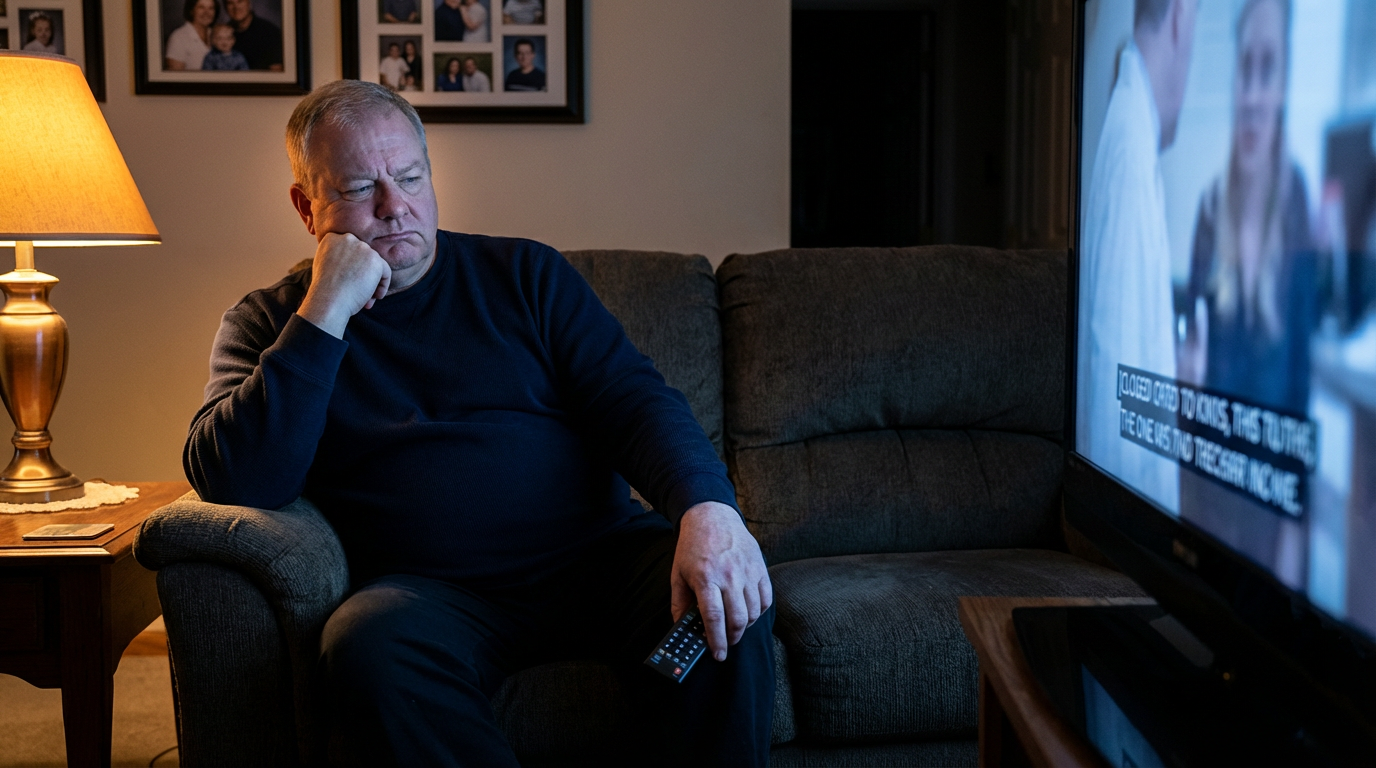
If you've started reading your TV instead of watching it, this is going to sound familiar.
I know what it's like to have the subtitles on every single show — even the ones you used to watch without them.
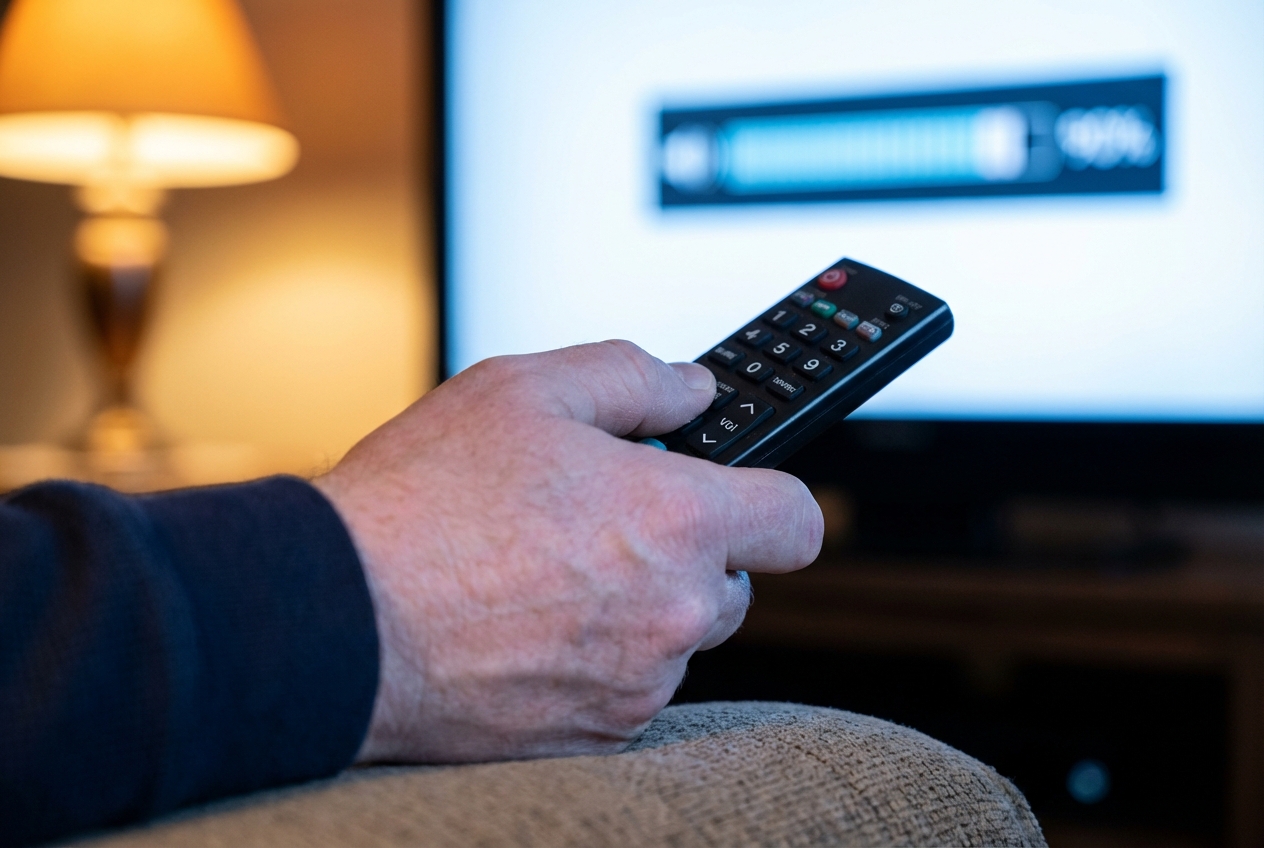
I know the volume dance. Up for the dialogue, down when the music hits, up again, down again — until you give up and turn on the captions.
I know the dinner table feeling. Three people talking at once, and you're nodding along because you lost the thread two sentences ago.
I know the fake laugh. The one where you caught the rhythm of the joke but not the words, so you smile a beat late and hope nobody noticed.
I know what it's like to turn down an invitation — not because you're busy, but because you already know you'll spend the evening pretending.
I know the exhaustion. Not the physical kind. The bone-deep mental tiredness that comes from trying to keep up, all day, every day.
And I know the thought that creeps in at night: Maybe this is just how it is now.
It's not.
What I'm about to share with you isn't another "turn up the volume" tip. It's the reason nothing you've tried has actually worked — and what people in your exact situation are doing about it right now.
It has nothing to do with your ears being "too far gone." It has everything to do with which sounds your ears are missing — and why no device you've tried has targeted those specific sounds.
Read this now. Not later. Not tomorrow.
This might be the turning point you didn't know you were looking for.
You know exactly where the subtitle text sits on every streaming service. Bottom third of the screen, white letters. Your eyes go there automatically now, before you've even registered you're doing it.
You're not watching the show anymore. You're reading it.
You didn't always watch TV this way. There was a time — not even that long ago — when you'd put on a show and just... watch. The dialogue was there. The story made sense. You didn't think about it.
Then one night, you missed a line. Then another. A character said something important — the line that explained the whole plot turn — and it dissolved into the background score. So you rewound. Turned the volume up a notch. Caught it the second time.
Then the action kicked in — way too loud. You grabbed the remote and turned it down.
"I am constantly turning up the volume to understand dialogue then down because the music is too loud, back and forth, back and forth."
That was the cycle. Volume up for the quiet scenes. Volume down when the effects hit. Up, down, up, down. Until one night you turned on the subtitles. "Just for this show," you told yourself.
That was years ago. The subtitles haven't turned off since.
"I need closed captioning to understand what is being said on TV."
You have a decent television. Maybe even a surround sound system. And the subtitles are still on anyway.
But the TV was just the first thing you noticed.
It took longer to admit what was happening at dinner.
Your family is sitting around the table. Three or four conversations going at once. Someone tells a joke — everyone laughs. You laugh too. A beat late. Because you didn't catch the punchline. You caught the cadence of the joke, the rising voice, the pause before the laugh — but the words weren't there.
You used to be in the middle of every conversation. Now you're at the edges.
A friend invites you to a dinner party. Last year you would have said yes without thinking. This time you hesitate. It's not that you don't want to go. You already know what's going to happen: you'll sit there, smiling politely, nodding at things you can't quite make out, exhausted by 8pm, and you'll drive home wondering why you bothered.
So you say no. "Busy tonight, sorry."
You're not busy. You're tired of pretending.
"I avoid socializing because I feel isolated in groups due to my hearing."
That line showed up in a forum post. Thousands of people related to it. Because this isn't just one person. It's the same pattern playing out in kitchens and restaurants and holiday gatherings everywhere.
You've tried things.
You turned the volume up — and your spouse started sleeping with earplugs. You bought a sound bar. Maybe you tried AirPods, thinking direct audio might help. Still muddled.
Maybe you went further. Maybe you looked into hearing aids, saw the price tags, read the mixed reviews. Maybe you even tried a pair. And they made everything louder — the TV, the AC hum, the kitchen fan — but the words still got lost in the noise.
"I have trouble understanding what is being said even with sound amplification."
Nothing was specifically wrong. But nothing was specifically right, either.
The breaking point isn't always dramatic. Maybe it's the night you're sitting next to your grandchild and they say something — looking right at you, big smile — and you have to ask: "What was that, sweetheart?" For the third time.
Maybe it's just the slow, accumulating weight of a hundred small moments where you were there, but you weren't really there.
"I feel left out of conversations because of my hearing."
You start to wonder: is this just how it is now?
But something doesn't add up. You can hear. Sounds are there. The TV isn't silent. People aren't miming at dinner. You hear the rise and fall of voices, the clink of glasses, the laughter. What's missing isn't sound. It's something inside the sound.
You start searching. Not for another gadget. For an answer.
And that's when something finally made sense.
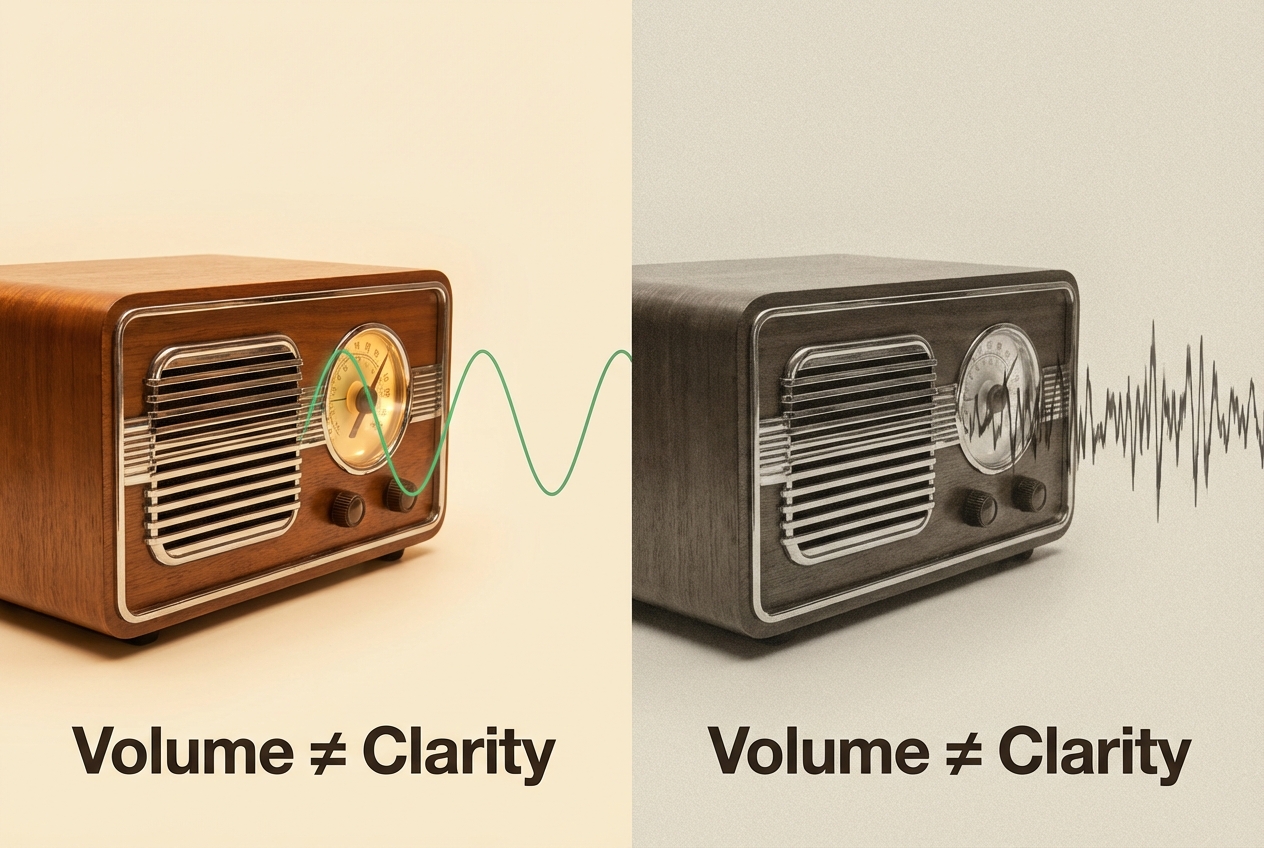
Think about a radio tuned slightly off the station.
You can hear something — a voice, music — but the words come through muddy.
Turn the volume up.
The static gets louder. The fragments get louder. The words don't get clearer.
Every spoken sentence carries two kinds of sounds. Vowels — ah, ee, oh — are loud and low-pitched. They usually come through fine.
Consonants — S, F, TH, SH — are different. They're soft. High-pitched. And they're the sounds your brain uses to tell one word from another.
Take three words: SIT. FIT. HIT.
The only thing separating them? That first consonant — high-pitched, and the first to fade.
When those consonants start going missing, you hear that someone is talking, but the detail that gives it meaning is gone. That's why people say: "I can hear you. I just can't understand you."
Turning up the volume doesn't fix this. More volume gives you more of what you could already hear. The clarity you're missing needs something different.
You've probably noticed the pattern. One-on-one at home — you manage. Walk into a restaurant — and you've lost the thread entirely.
In a quiet room, your brain fills in the gaps. In a noisy room — background voices, silverware, music — the noise lands in the same frequency range as the speech you need. Your brain can't separate them.
Here's what nobody tells you: your brain is running a constant reconstruction job — predicting, guessing, filling in. By evening, you're not just tired. You're drained. That withdrawal from social settings? It's your brain protecting itself.
It's not you. It's not that you're "getting old." Your brain is working significantly harder than everyone else's just to follow along.
Which means any real solution needs to do four things:
- Target your specific frequency gaps — not a generic boost
- Adapt to different environments — your living room and a restaurant are different problems
- Let you control it in real time — adjust in the moment, not rely on presets
- Get better as you learn your own patterns
Until recently, meeting all four meant $2,000+ and a clinic visit. That's changed.
Once you understand the real problem — frequency-specific clarity, not volume — the question becomes obvious:
Why isn't anyone building something that targets the sounds I'm missing, in the room I'm in right now, and lets me adjust it myself?
I asked the same question.
I looked at what was available. Basic devices that boost everything equally — dialogue, background noise, all of it. Premium hearing aids that cost $3,000-$5,000 and require multiple audiologist visits. Streaming gadgets that need HDMI splitters, optical cables, and a degree in home electronics just to set up.
None of them solved the core problem: giving you control over the specific frequencies where speech clarity lives, in the specific environment you're in, adjustable by you in real time.
Then I found a team that had already built it.
A group of audio engineers who understood that the challenge isn't making things louder — it's making the right things clearer. They'd designed a system where you choose your environment, tune three frequency bands, and the clarity adjusts to YOUR ears in YOUR room.
They'd tested it at kitchen tables with three conversations going at once. In living rooms with the TV at normal volume. In restaurants where every other solution had failed.
And they refused to ship until it met all four criteria.
No cables. No streaming boxes. No appointment required.
The Hearstic Clarity
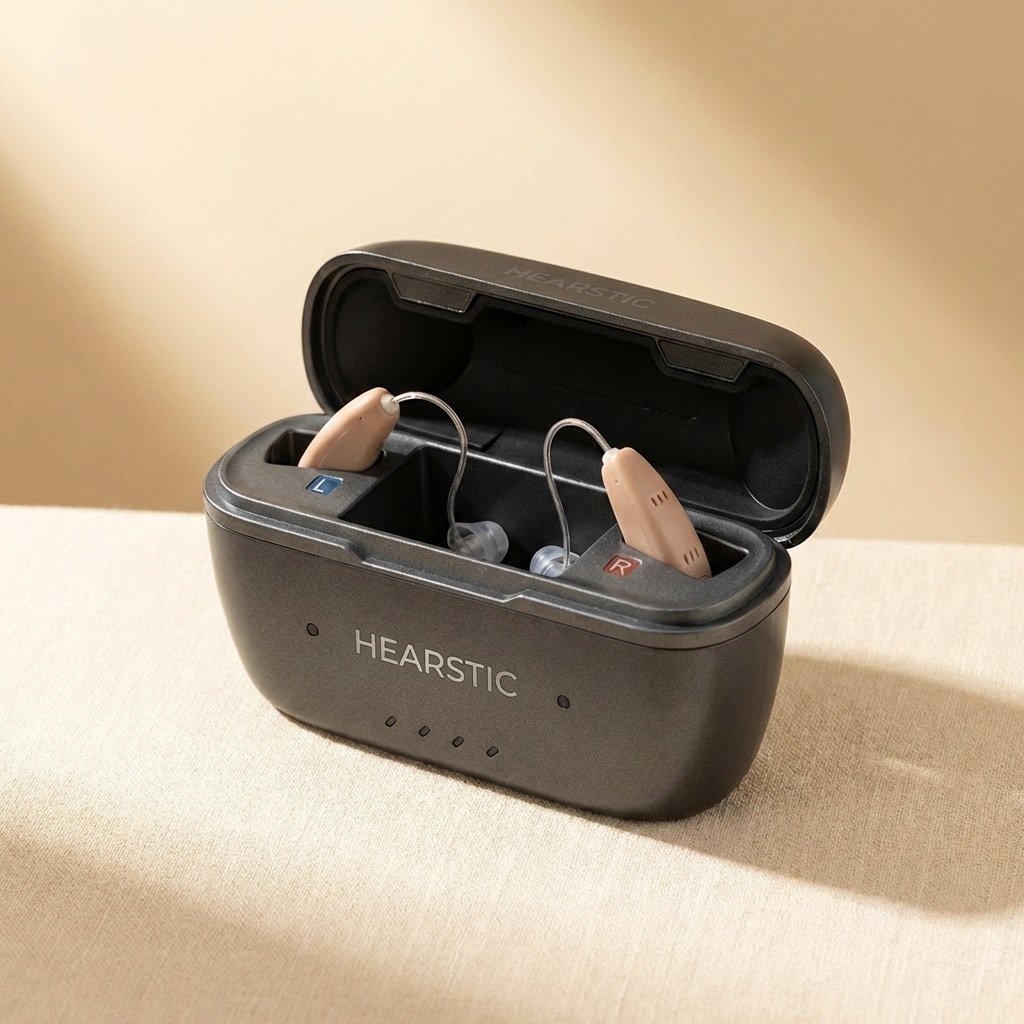
It's called the Hearstic Clarity. An OTC hearing aid built for exactly the problem you just read about.
Here's how it works.
The Clarity uses what we call Clarity — and it maps directly to the four criteria that matter:
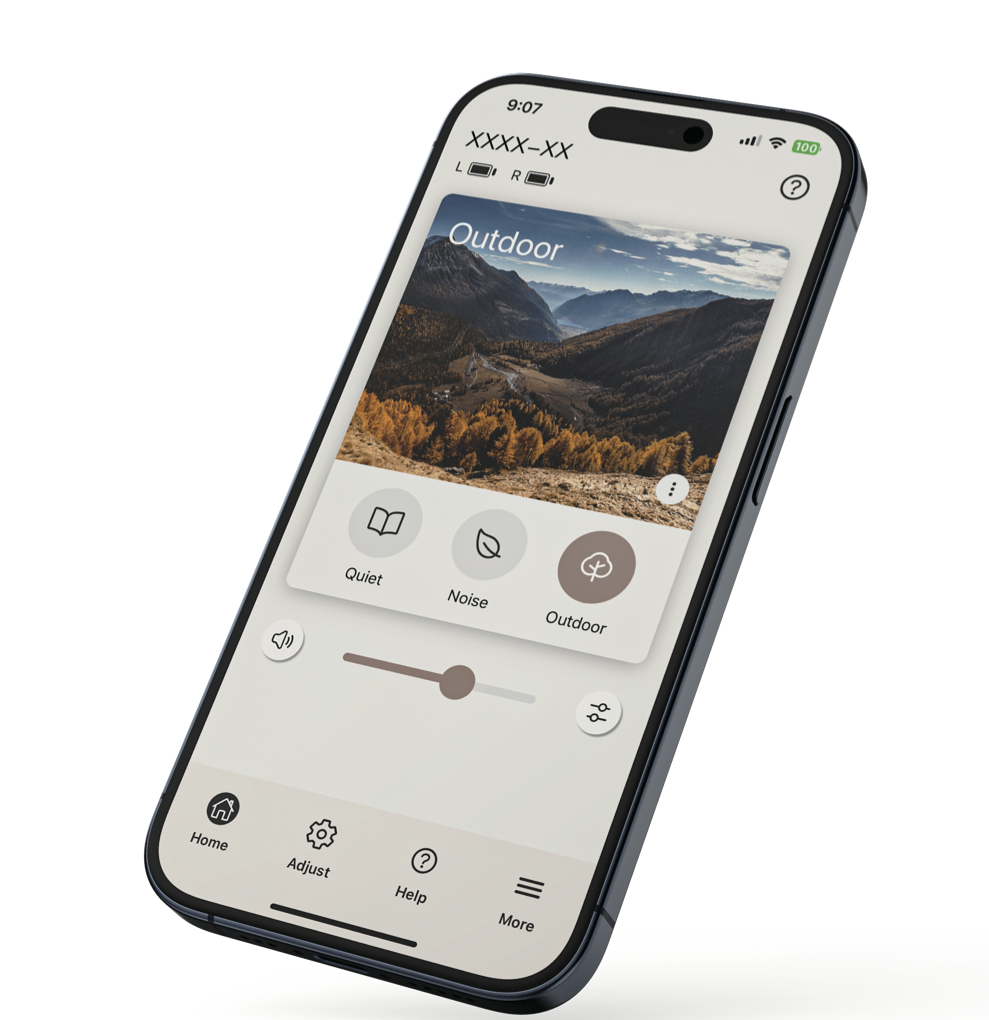
Your frequency gap, not an average. The HA-Link app gives you real-time control over three sound bands — Bass, Middle, and Treble. Those consonant sounds that carry speech clarity — S, F, TH — live in the Middle and Treble range. You boost exactly where your clarity is fading. Each ear independently.
Your environment, not a guess. Three modes built in — Quiet, Noise, and Outdoor. Walking into a restaurant? Switch to Noise mode. Watching TV at home? Quiet mode filters the ambient hum so dialogue comes through at a comfortable volume.
You stay in control. The HA-Link app adjusts from your phone. In any room. At any moment. No audiologist. No waiting room. If it doesn't sound right, you change it. Right now.
It gets better as you learn. Not a locked-in setting from day one. The more you use it, the more you discover what YOUR ears need in each situation.
Noise Reduction cuts background clutter. Whistle Suppression handles feedback. Battery runs over 20 hours per charge, recharges in 2 hours. Works with Android 9+ and iOS 12+.
If you can adjust the volume on your phone, you can use Clarity.
This isn't about making your world louder. It's about hearing the people in it clearly.
Free shipping · 90-day money-back guarantee
What People Are Saying
“Went to my daughter's dinner party last weekend and followed every conversation at the table. Didn't ask anyone to repeat themselves. Not once. My wife said I seemed like a different person. I wasn't different — I could just hear.”
— David R., 64 · Portland
“First time in years I watched the evening news without subtitles. I kept waiting for the moment I'd need to turn them back on. It never came. I sat there for an hour just watching. Like I used to.”
— Margaret T., 71 · Austin
“I'd been skipping team happy hours because I couldn't follow anyone in a noisy bar. Wore these last Friday. Heard every word. Stayed till close. Felt like myself again.”
— James K., 58 · Chicago
Imagine This
First week. You're sitting in your living room. TV at a normal volume — the volume your spouse watches at. No subtitles. A character speaks quietly, and you catch every word. You don't rewind. You don't reach for the remote.
First month. Your daughter invites you to dinner. Six people at the table, three conversations overlapping. You switch to Noise mode before you sit down. Someone tells a joke — and you laugh at the right time. Because you actually heard it.
By 90 days. You've stopped thinking about it. The adjustments are second nature. You know your Quiet mode settings for TV, your Noise mode for restaurants. You don't avoid gatherings anymore. You don't fake understanding. You show up — and you're actually there.
That's not a fantasy. That's what people describe after a few weeks with Clarity.
Free shipping · 90-day money-back guarantee
Let's Talk About What This Normally Costs
Traditional hearing aids from an audiologist: $2,000 to $5,000 per pair — plus fitting appointments, follow-up visits, and weeks on a waiting list.
Premium clinic-fit devices with app control: $3,000+.
Basic Bluetooth TV streamers and adapter kits: $150-$300 — and they still don't target the specific frequencies where speech clarity lives.
Sound bars, amplified speakers, AirPods: none of them address the root problem.
You've already spent money trying to solve this. The question isn't what it costs — it's what it costs you to keep living with the problem.
The Clarity has been selling faster than we planned. We don't run fake countdown timers. But we produce in controlled batches, and the last two restocks moved out within the first week.
This isn't a $30 "personal sound device" from a late-night ad. It's not a generic sound booster that makes everything louder.
And it's not a $4,000 pair of prescription hearing aids that takes three appointments and six weeks to dial in.
It's the space between: OTC hearing aid technology with the kind of real-time tuning that used to require clinic visits. Without the clinic. Without the cables. Without the price tag.
Hearstic Clarity
$299
Full kit — both hearing aids, charging case, dome tips, cleaning tools. No monthly subscription. No hidden fees. Less than $1 a day over the first year.
What You Get
- ✓A pair of OTC hearing aids with Clarity technology
- ✓The HA-Link companion app (Android 9+ / iOS 12+)
- ✓3 environment modes pre-configured — Quiet, Noise, Outdoor
- ✓Real-time 3-band EQ with independent left/right control
- ✓Noise Reduction and Whistle Suppression built in
- ✓20+ hours of battery life per charge
- ✓Charging case that holds 3 additional full charges
- ✓Bluetooth call and audio support
- ✓Full setup guide — no audiologist appointment required
Free shipping · 90-day money-back guarantee
The Cost of Waiting
Every group dinner you skip is another memory you don't make. Every show you watch with subtitles is another evening of reading instead of relaxing. Every time you nod along pretending to understand, the gap between you and the people you care about gets a little wider.
Hearing difficulty doesn't stay the same. The compensating your brain does today gets harder tomorrow. The fatigue compounds. The withdrawal deepens.
Six months from now, you'll either be glad you acted — or you'll wish you had.
90-Day Money-Back Guarantee
We don't want you to guess. We want you to try it. That's why every order comes with a 90-day money-back guarantee. Not 30 days. Not 60. Ninety full days to test it in your living room, at the dinner table, in a restaurant, at a family gathering — every situation where hearing clarity matters to you. If it doesn't work for your ears, in your life — send it back for a full refund. No restocking fee. Free return shipping. And every Clarity is backed by a 2-year manufacturer warranty — full replacement for any manufacturing defects. We're not asking you to take a leap of faith. We're asking you to try it for 90 days, in your actual life.
- Full refund
- No restocking fee
- Free return shipping
- 2-year manufacturer warranty
Free shipping · 90-day money-back guarantee
Frequently Asked Questions
Most people notice clearer dialogue within the first few days. The real improvement comes over the first 2-3 weeks as you dial in your settings for different environments. The 90-day guarantee gives you plenty of time.
No. The Clarity is an OTC hearing aid designed for adults 18+ with perceived mild to moderate hearing difficulty. No prescription needed. If you experience sudden hearing changes, ear pain, or dizziness, see a healthcare professional first.
Yes — and you don't need cables, streaming boxes, or TV adapters. The Clarity processes sounds around you and lets you tune the specific frequencies where dialogue lives. Switch to Quiet mode for home TV watching. Adjust the EQ in the app. That's it.
Yes. The HA-Link app supports Android 9+ and iOS 12+. Many hearing aids require Apple's MFi protocol. The Clarity connects via standard Bluetooth — no special phone required.
Over 20 hours per charge. Full recharge takes 2 hours. The charging case holds about 3 additional full charges — so you get days of use before plugging anything in.
Return it within 90 days for a full refund. No restocking fee. Free return shipping. If Clarity doesn't improve your clarity, we want you to get your money back.
The Clarity is a receiver-in-canal (RIC) design — one of the smallest and most comfortable styles available. It comes with multiple dome tip sizes. Most people forget they're wearing them within the first hour.
Yes. The Clarity supports Bluetooth audio and calls with a 10-meter range. It auto-switches between hearing aid mode and call mode — no manual toggling needed.
Both hearing aids (left and right), a Type-C charging case, dome tips in multiple sizes, a cleaning brush, wax guards, a charging cable, and user guides. Everything you need — nothing else to buy.
Hearing aids, including the Clarity, may not fully replace your natural hearing ability, and they do not prevent or improve medical conditions that cause hearing loss. What they can do is make the sounds you're missing more audible and distinct — especially speech clarity in environments where it matters most. Clarity gives you the tools to optimize that clarity yourself, in real time.
One More Thing
Researchers have found associations between prolonged untreated hearing difficulty and higher risk of cognitive decline. The Lancet Commission identified it as one of the most significant modifiable risk factors. The FDA itself notes that using hearing aids may help reduce these risks.
We're not saying this to scare you. We're saying it because waiting has a cost that goes beyond missed conversations.
We can't make this decision for you. But if you've been reading this and thinking "that's exactly what I'm going through" — the 90-day guarantee means you don't have to decide forever.
You just have to decide to try.
Free shipping · 90-day money-back guarantee
Hearstic Clarity is an OTC hearing aid intended for adults 18 and older with perceived mild to moderate hearing loss. It may not fully replace natural hearing ability and does not prevent or improve medical conditions causing hearing loss. Individual results may vary. If you experience sudden hearing changes, ear pain, drainage, or dizziness, consult a healthcare professional before use.